


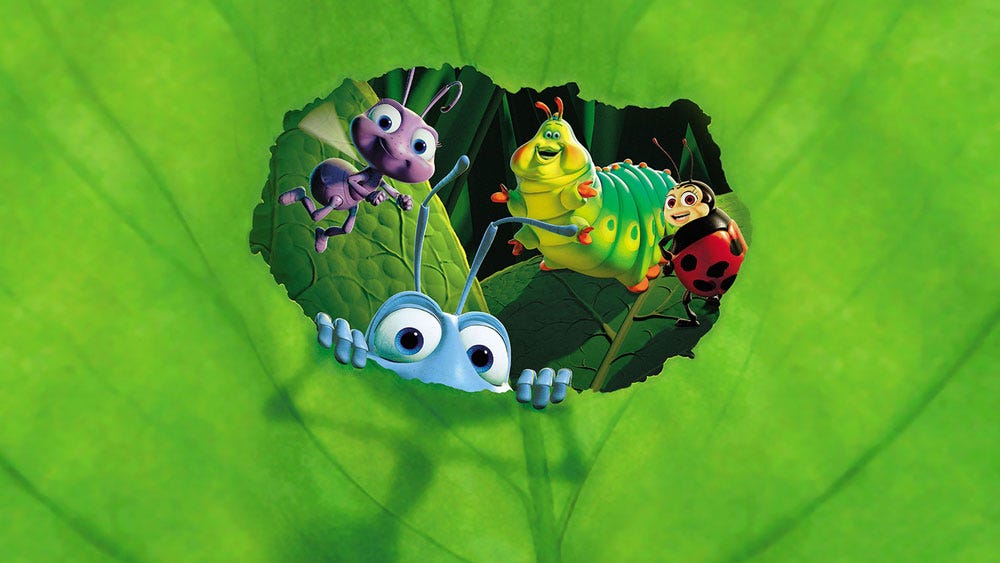
It’s A Bug’s Life!! If you know, you know…^
This autumn Earthling News dispatch is dedicated to the little ones.
The flying, buzzing, creepy crawling ones.
The orange and black ones, choosing the silver lace blossoms in our backyard for their late afternoon orgies. Why they’re drawn to these flowers in particular I don’t know, but I remember them from last year. In August and into September they were everywhere — crawling, napping in flowers, falling into our water bucket, flailing and ending up drowned, or saved by one of our human hands scooping them up and tossing them out, to live another day.
Matters of timing.
Little bugs have me thinking about time
and the experience of a life.
Their lives are short,
compared to ours.
Our lives are short,
compared to this clam called an Ocean Quahog that can live for 500 years !
That clam’s life is short, compared to a Bristlecone pine tree. (The oldest known species of which is almost 5,000 years old ya’ll!)
A bristlecone’s life is short, compared to the life of our planet (4.5 billion years). How to even fathom?
[Sidenote: I read somewhere (?) recently that we’re living in the halfway point of our Earth’s estimated lifespan. Are we in a midlife crisis ?]
I wonder if the two-month life of a fruit fly feels as full and layered and arduous, luminous as a human life, or a sparrow’s, a whale’s, a bear’s, or the Earth’s itself? If the being that’s living the life is fully present in it, does it matter?
I sit against a tree in the park for a brief meditation on my lunch break. A soft, spacious cloud of tiny white creatures gather and hover around me. Floating like ethereal orbs to my un-spectacled eyes. Then, an itch at my ankle and a reactive smoosh. A little black speck of a body, wiped on the grass.
Flies in particular seem to be universally disliked by humans. Scavengers of shit and death, things we’d rather not think about. But there’s a plot-twist: apparently (I just learned this) flies are also very important pollinators, and have a direct impact on our food supply. Without bugs would we have any food at all?
In other news, I was shocked to find a dreaded, magnificent hornworm on one of my four cherry tomato plants last week. At first I was excited, thinking, “If my small, water deprived little garden is attracting a hornworm I must be doing something right!”
But then there were 3 more. And then 14! We had to kill them or say goodbye to our tomatoes. It takes an unsettling amount of effort to smash and squish these big worms. I’m sorry and conflicted. You won’t become the commanding, enchanting moths I know you could be.
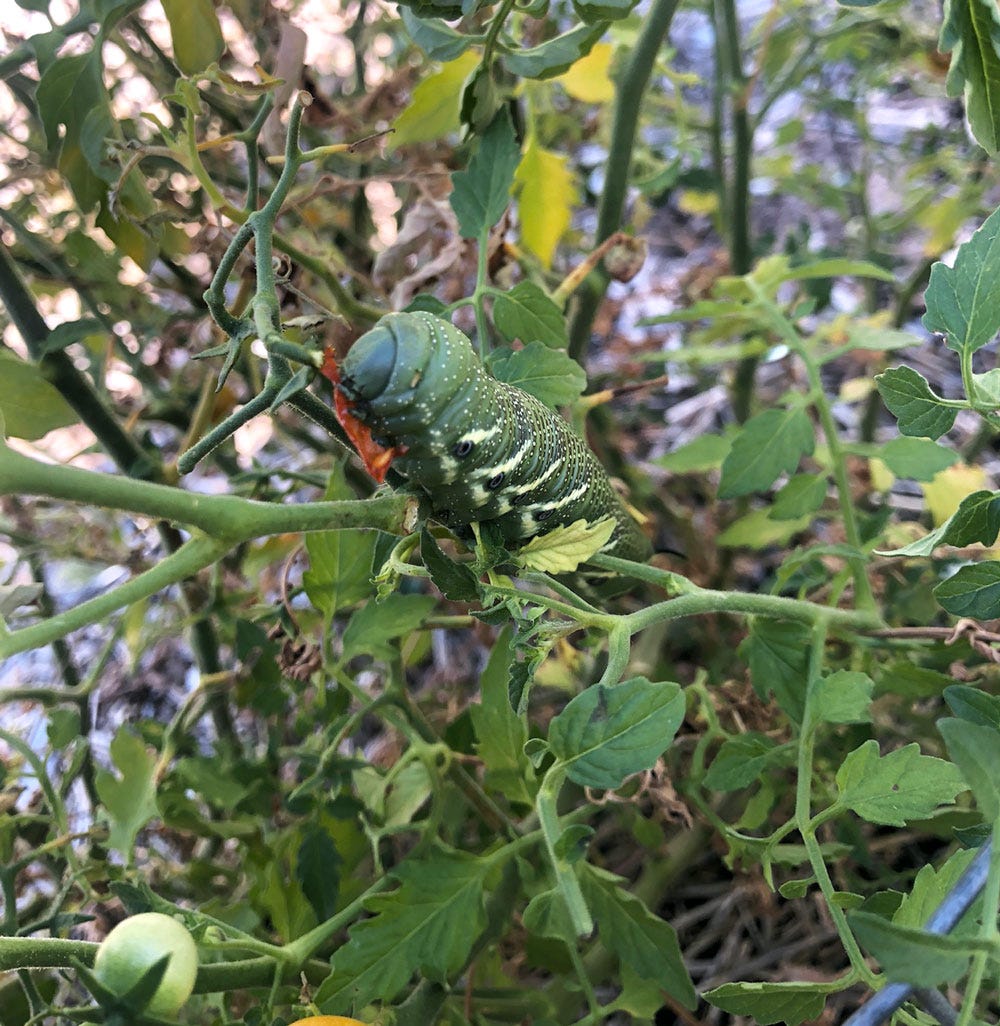
Hornworm gnawing tomato leaves. ^
Thank goodness the grasshoppers have backed off. Where do they go? Do they burrow into the soil? Things I could learn on the internet, that I’d rather just wonder about for now.
Instead, I read this article of someone analyzing the 1998 classic “A Bug’s Life” (& inspiration for the title of today’s newsletter) as an allegory of the common people fighting back against a colonizing force (the power hungry grasshoppers). Dang.
In recent years, research has shown that insect populations around the globe are seriously threatened by habitat loss and warming temperatures1. Everything at every level is affected.
“We cannot escape our involvement any more than we can escape breathing the air that has traveled from plants thousands of miles away.” 2
Bugs having me think about scale.
I remember being shown the short film “Powers of Ten” by Charles and Ray Eames in a class in college. A couple of humans relaxing at a park in Chicago is the axis point for a sequence that starts by zooming way out, into the sky, into the upper atmosphere, out past the Earth into the solar system, our galaxy, and further beyond, beyond, beyond. Then the movement reverses, back down until eventually sinking into the hand of the man napping on his picnic blanket, into his cells, DNA, atoms, energetic particles and beyond, beyond beyond… At some point, in each direction, we reach the limit of our understanding.

[Sidenote: “beyond, beyond…” has me think of the Buddhist Heart Sutra:
गते गते पार गते पार संगते बोधि स्वाहा
Gate, gate, pāragate, pārasaṃgate, bodhi svāhā
Gone, gone, gone beyond, gone beyond beyond, Hail the Goer!]
Remembering the many levels of realities that are happening at once helps me loosen my grip on the drama of my individual life, and at the same time wildly increases the drama of LIFE as a whole. So many things happening at once, at micro and macro and everything in between, all affecting each other.
Looking at the stars, and contemplating the massive mystery of space and Deep Time can be a balm for my modern-life-chapped soul. Watching ants and bees and moths and worms reminds me of the complex worlds unfolding on another, equally humbling scale, that my life directly depends on. Do the ants depend on me too? I’m not sure, but I leave them gifts now and then to snack on.
From what I’ve observed, insects are incredibly focused and dedicated to their tasks. Ants in particular seem to be undeterred by any and all forces that could get in the way of their vocation: to serve their society, and their queen. To carry this breadcrumb that’s 5 times its size across a huge rock field (gravel driveway) back home to feed the family. Everything they do is in service to the health of the collective. “Apart from the community, any one individual cannot properly function or survive”. Health of community = health of self. Survival of self = survival of community.
Lots more to learn from the little ones.
Ants investigating the remnants of a honeycomb, in front of harvest altar. ^
You are invited to share your Earthling observations and experiences for future letters! Send them to me here:
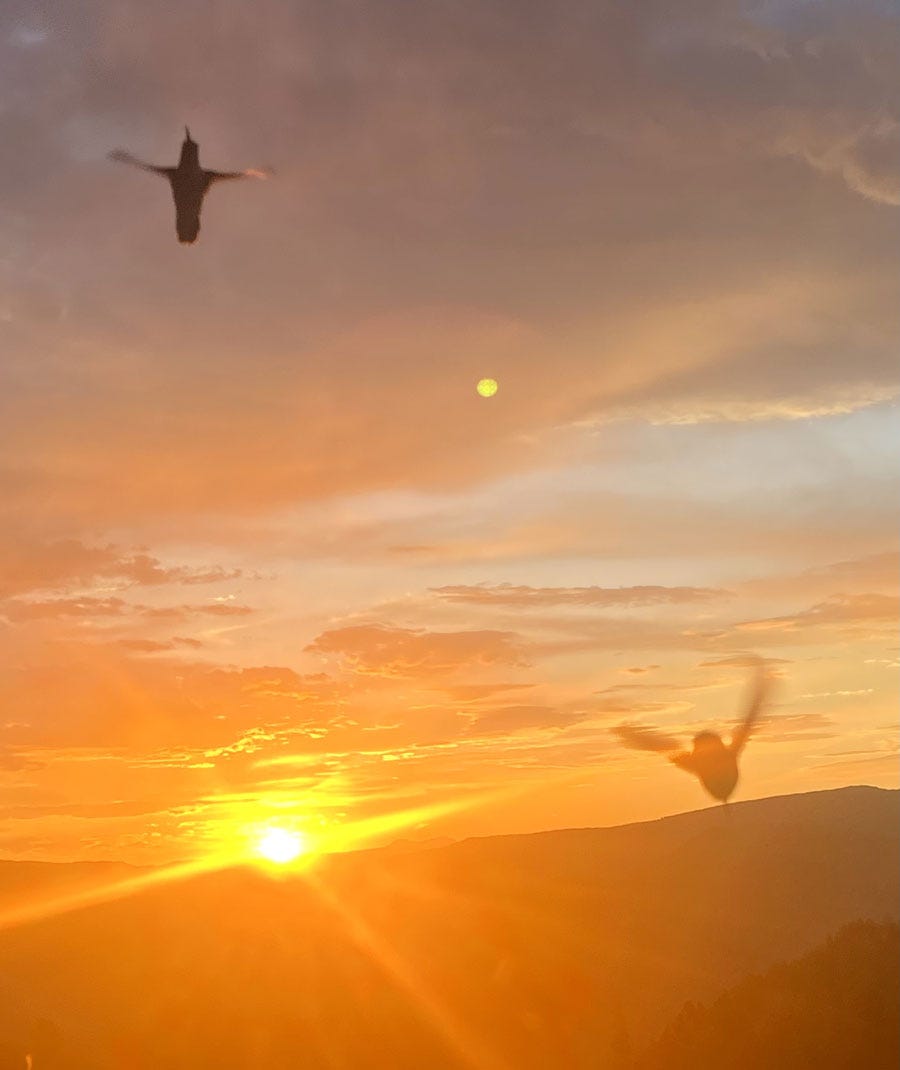
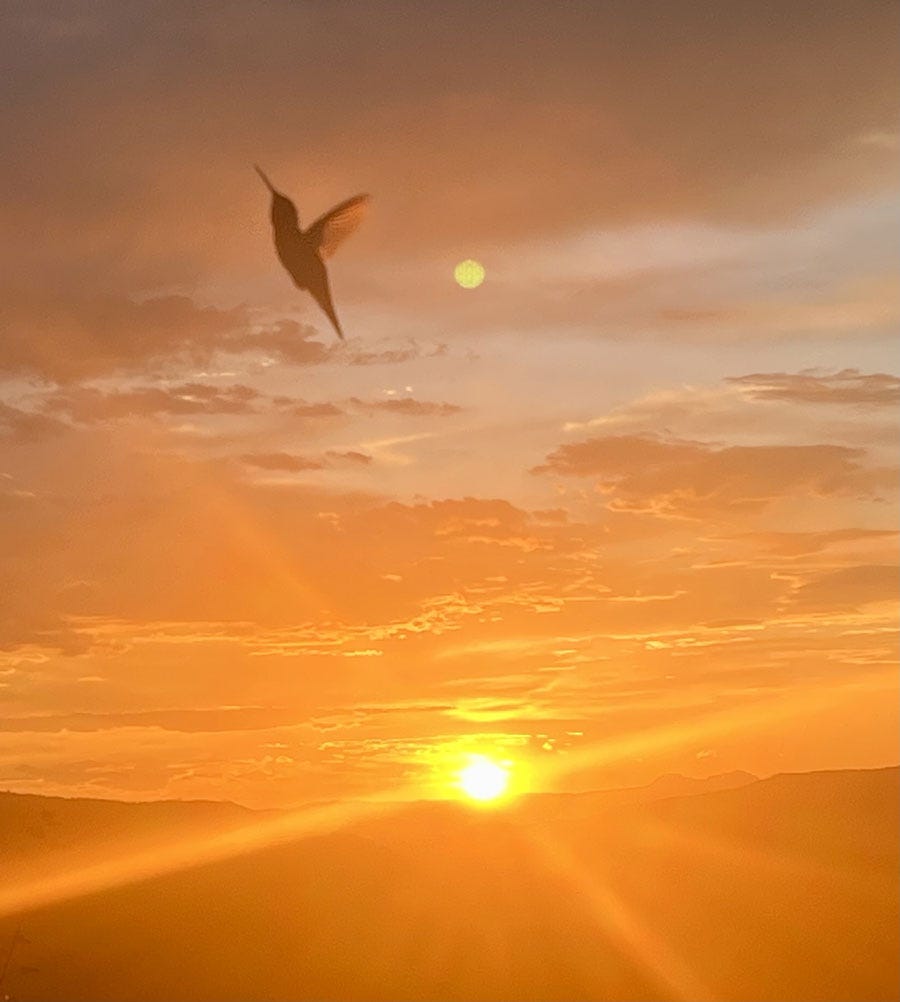
Thank you Diane for sharing the following photos of these beings big and small <3
From an article about “insect apocalypse”:
“Researchers analyzed data from a 20-year period for more than 6,000 locations and studied nearly 18,000 insect species, including butterflies, moths, dragonflies, grasshoppers and bees.
They concluded that in areas with low-intensity agriculture, less climate warming, and a nearby natural habitat, insects only declined by 7%, compared to the 63% decrease in areas with less natural habitat cover.”
********* Create Your Own Pollinator Garden ! ************
Earth Prayers from around the World. Edited by Elizabeth Roberts and Elias Amidon